Disclosure: this post contains affiliate links. If you buy through them, we may earn a commission at no extra cost to you. Product details and prices were checked in October 2026 and can change. This article is for general information only and is not medical advice. Talk to your doctor or another qualified healthcare provider before starting a vitamin D or vitamin K supplement, especially if you take medication, are pregnant or breastfeeding, or have a health condition.
Vitamin D and vitamin K2 have become one of the most popular supplement pairings of the past decade. You’ll find them together in capsules, softgels, gummies and liquid drops, often marketed with promises about bones, heart health and immunity. But why are these two vitamins paired, how much do you actually need, and how do you choose a good supplement without overdoing it?
This guide answers those questions using official guidance from the National Institutes of Health (NIH), then takes a close look at one well-regarded option: the liquid D3K2 from Quicksilver Scientific. Along the way, we’ll cover the difference between D2 and D3, why the form of vitamin K2 matters, how to avoid taking too much, and the medication interactions everyone should know about.
See Quicksilver Scientific D3K2
Vitamin D: the basics
Vitamin D helps your body absorb calcium, which is essential for building and maintaining strong bones. According to the NIH Office of Dietary Supplements, vitamin D, together with calcium, helps protect older adults from osteoporosis. It also plays a role in muscle movement, nerve signaling and immune function (NIH ODS).
How much vitamin D do you need?
The NIH lists these recommended daily amounts:
| Life stage | Recommended amount |
|---|---|
| Birth to 12 months | 400 IU (10 mcg) |
| Children and teens, 1 to 18 years | 600 IU (15 mcg) |
| Adults, 19 to 70 years | 600 IU (15 mcg) |
| Adults 71 and older | 800 IU (20 mcg) |
| Pregnant and breastfeeding teens and women | 600 IU (15 mcg) |
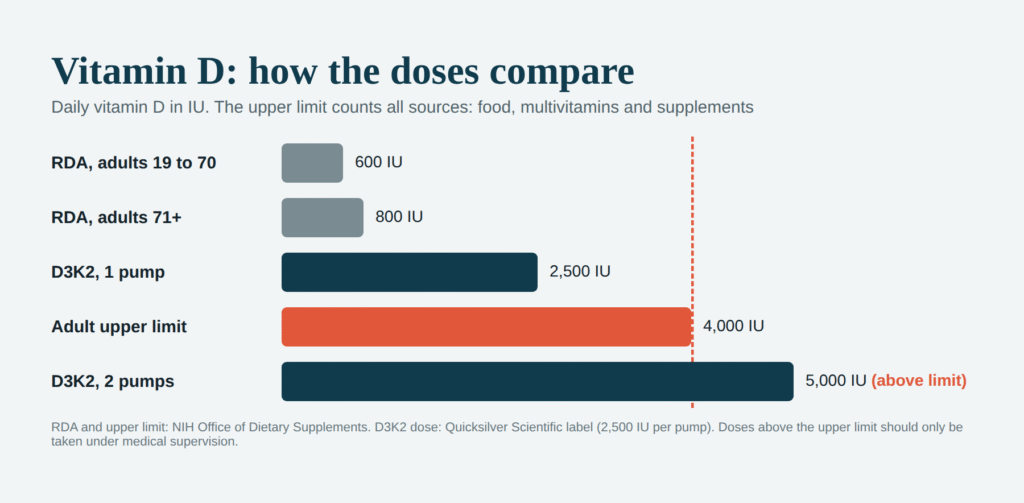
Just as important is the upper limit: the most you should get each day from all sources combined, unless your doctor advises otherwise. For adults, that’s 4,000 IU (100 mcg) a day (NIH ODS). We’ll come back to this when we look at supplement doses, because it matters.
Where vitamin D comes from
- Sunlight. Your skin makes vitamin D when it’s exposed to the sun. Clouds, smog, older age and darker skin all reduce how much you make, and window glass blocks it. Because sun exposure also raises skin cancer risk, experts recommend sunscreen for time outdoors beyond a few minutes.
- Fatty fish. Trout, salmon, tuna and mackerel are among the best natural food sources.
- Fortified foods. Most milk in the US is fortified with about 120 IU per cup, and many plant milks, cereals and orange juices are fortified too.
- Smaller amounts come from beef liver, egg yolks, cheese and mushrooms, especially UV-treated mushrooms.
Who may have trouble getting enough
The NIH highlights several groups who may not get enough vitamin D (NIH ODS):
- breastfed infants,
- older adults,
- people who rarely expose their skin to the sun,
- people with dark skin,
- people with conditions that limit fat absorption, such as Crohn’s disease, celiac disease or ulcerative colitis,
- and people with obesity or who have had gastric bypass surgery.
Season and location matter too. In winter, especially in northern parts of the US, the sun is often too low for your skin to make much vitamin D, and most people spend more time indoors.
Vitamin K: the basics
Vitamin K is best known for its role in blood clotting, but it’s also needed for healthy bones (NIH ODS). It comes in two main forms:
- Vitamin K1 (phylloquinone) is found mainly in green leafy vegetables such as spinach, kale, broccoli and lettuce. It’s the main form in most people’s diets.
- Vitamin K2 (menaquinones) comes in several types, including menaquinone-4 (MK-4) and menaquinone-7 (MK-7). K2 is found in smaller amounts in meat, cheese and eggs, and in fermented foods. A traditional Japanese fermented soybean dish called natto is especially rich in MK-7.
The NIH’s recommended daily amounts for adults are 120 mcg for men and 90 mcg for women (NIH ODS). Vitamin K deficiency is very rare in the US, though some groups, such as people with conditions that reduce fat absorption or who have had bariatric surgery, are at higher risk.
Why pair vitamin D3 with K2?
The rationale comes down to calcium.
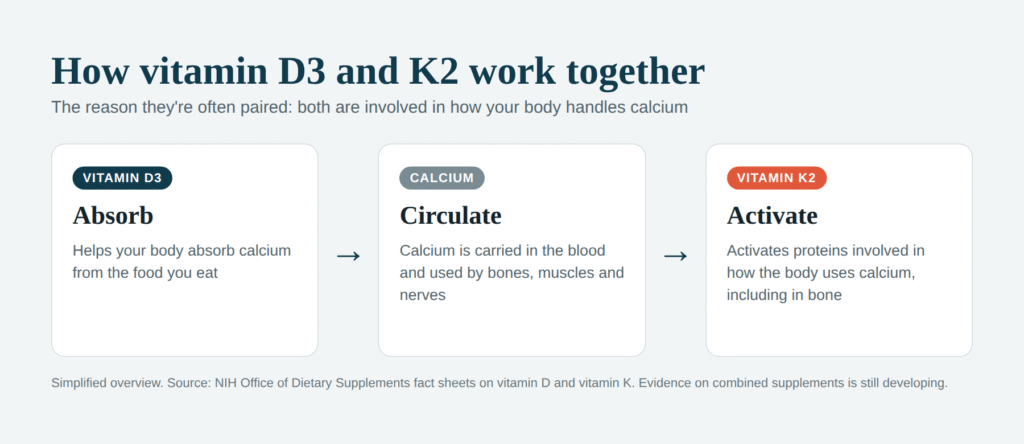
Vitamin D helps your body absorb calcium from food. Vitamin K, in turn, is needed to activate certain proteins involved in how the body uses calcium, including proteins involved in bone mineralization. Supplement makers pair the two on the idea that they work as a team: D helps bring calcium in, and K2 helps the body put it to use.
It’s a logical pairing, and researchers have been interested in how the two vitamins interact. That said, the evidence on specific health outcomes from taking them together is still developing, and official intake recommendations are set separately for each vitamin. A combined supplement is a convenient way to get both, not a guaranteed upgrade over getting each from food and, where needed, separate supplements.
Forms matter: D2 vs. D3, MK-4 vs. MK-7
Vitamin D2 vs. D3
Supplements use one of two forms of vitamin D. Vitamin D2 (ergocalciferol) comes from plant and fungal sources. Vitamin D3 (cholecalciferol) is the form your skin makes from sunlight. Both raise vitamin D levels in the blood, and D3 is the most common form in combination supplements like D3K2.
Vitamin K2 as MK-4 vs. MK-7
The two most common forms of K2 in supplements are MK-4 and MK-7. MK-7 tends to stay in the body longer, which is one reason it’s popular in once-daily supplements. MK-4 is often used in higher doses. If a label just says “vitamin K2” without specifying the form, it’s worth asking the manufacturer which one it is.
How much is too much?
This is the part many supplement articles skip, so let’s be clear.
Vitamin D is a fat-soluble vitamin, which means your body stores it rather than flushing out the excess. Taking too much over time can raise your blood levels too high. The NIH notes that very high levels, almost always caused by excessive supplement use rather than sunshine, can cause nausea, vomiting, muscle weakness, confusion, pain, loss of appetite, dehydration, excessive thirst and urination, and kidney stones. In extreme cases, it can be much more serious (NIH ODS).
Some practical points:
- Count every source. The 4,000 IU adult upper limit includes food, fortified drinks, multivitamins and any other supplements, not just your D3K2.
- Ask about a blood test. A blood test for 25-hydroxyvitamin D, often called a vitamin D level, is the usual way doctors check your status. It can help you and your provider decide whether you need a supplement and how much.
- Higher doses need supervision. Doctors sometimes recommend more than the upper limit for a limited time to correct a deficiency. That’s a decision for your provider, based on your test results, not something to do on your own.
Medication interactions to know
Both vitamins can interact with medicines. The most important to know:
- Warfarin and other blood thinners. Vitamin K directly affects how warfarin works. A sudden change in vitamin K intake can interfere with the medicine; eating less can increase bleeding risk, and eating more can increase clotting risk (NIH ODS). If you take any anticoagulant, don’t start a K2 supplement without talking to your doctor.
- Orlistat (Xenical, alli) can reduce vitamin D absorption.
- Statins may work less well with high-dose vitamin D.
- Prednisone can lower vitamin D levels.
- Thiazide diuretics, combined with vitamin D supplements, can raise blood calcium too high (NIH ODS).
If you take any prescription medicine, check with your doctor or pharmacist before adding a vitamin D or K supplement.
Calcium: the third piece of the puzzle
Talking about vitamin D and K2 without mentioning calcium is like talking about a delivery truck without mentioning the cargo. Both vitamins matter for bones largely because of what they do with calcium, so it’s worth knowing how much calcium you need too.
The NIH recommends these daily calcium amounts for adults (NIH ODS):
| Adults | Recommended calcium |
|---|---|
| Men and women, 19 to 50 years | 1,000 mg |
| Men, 51 to 70 years | 1,000 mg |
| Women, 51 and older | 1,200 mg |
| Men, 71 and older | 1,200 mg |
Good food sources include milk, yogurt and cheese, canned sardines and salmon with soft bones, calcium-fortified plant milks, juices and cereals, tofu made with calcium, and some leafy greens such as kale and bok choy. Many people get most or all of their calcium from food. If you take a calcium supplement, keep in mind that there’s an upper limit for calcium too, and that many calcium supplements already contain vitamin D. That’s another reason to read every label in your cabinet before adding a D3K2 product.
Bone health beyond supplements
Vitamins are only one part of keeping your bones strong. Some of the most effective habits cost nothing:
- Weight-bearing and resistance exercise. Walking, hiking, dancing, climbing stairs and strength training put healthy stress on your bones, which helps maintain them. Talk to your doctor before starting a new exercise program if you have health concerns.
- Enough protein. Bone is a living tissue with a protein framework, so a balanced diet with adequate protein supports it.
- Not smoking. Smoking is linked with lower bone density and higher fracture risk.
- Limiting alcohol. Heavy drinking is associated with bone loss and a higher risk of falls.
- Preventing falls. For older adults especially, good lighting, sturdy footwear, balance exercises and removing tripping hazards at home matter as much as bone density.
If you’re concerned about your bone health, ask your doctor whether a bone density scan is right for you. Supplements work best as a supporting player in a broader plan, not as a replacement for one.
Liquid, softgel or gummy?
Vitamin D3 and K2 come in several formats, and the best one is simply the one you’ll take consistently at the right dose.
- Softgels and capsules are inexpensive, tasteless and easy to travel with. The trade-off is a fixed dose per pill, which makes it harder to take a smaller amount.
- Gummies are easy to remember and pleasant to take, but they usually contain added sugar and it’s easy to treat them like candy. Keep them away from children.
- Liquid drops and pumps, like Quicksilver’s D3K2, make it easy to adjust the dose and suit people who struggle with pills. They usually cost more per serving and need a little more care to measure.
Whatever format you choose, compare the amount of vitamin D per serving with your needs, because doses vary widely, from a few hundred IU to 5,000 IU or more per serving.
How to choose a D3K2 supplement
With so many options available, a simple checklist helps.
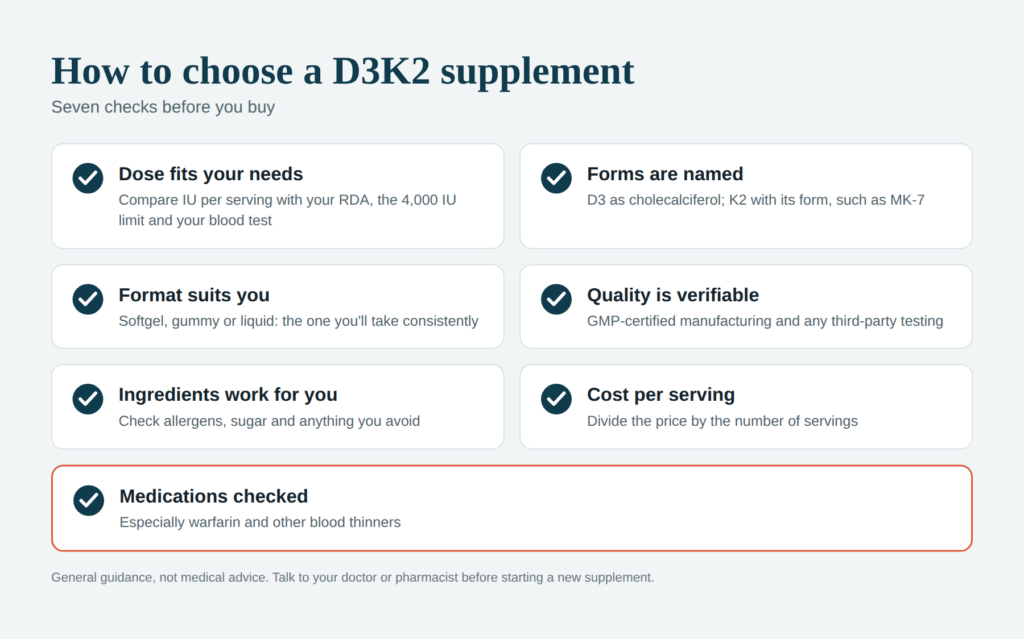
- The dose fits your needs. Compare the vitamin D per serving with the recommended amount for your age and the 4,000 IU adult upper limit, and with what your provider suggests based on your blood levels. More isn’t automatically better.
- The forms are clear. Look for D3 as cholecalciferol and K2 with its form named, such as MK-7.
- The format suits you. Capsules and softgels are convenient for travel. Liquids make it easy to adjust the dose and suit people who dislike swallowing pills.
- Quality is verifiable. Look for manufacturing in a GMP-certified facility and any third-party testing or certifications.
- Other ingredients are acceptable. Check for allergens, sugar, alcohol and anything you avoid.
- The cost per serving makes sense. Divide the price by the number of servings to compare fairly.
Compare D3K2 details at Quicksilver Scientific
Spotlight: Quicksilver Scientific D3K2
Quicksilver Scientific is a supplement company based in Louisville, Colorado, founded by Christopher Shade, PhD. It’s known for liposomal and nanoemulsion liquid supplements, and its D3K2 is one of its best sellers. Here’s how it measures up against the checklist, based on the product page in October 2026 (Quicksilver Scientific).
What’s in it
- Vitamin D3 as cholecalciferol: 2,500 IU (62.5 mcg) per serving, listed as 313% of the Daily Value
- Vitamin K2 as menaquinone-7 (MK-7): 90 mcg per serving
- Serving size: 0.5 mL, which is 1 pump
- Bottle: 1.7 fl oz (50 mL), about 100 servings
- Format: a liquid nanoemulsion, taken by mouth
- Label claims: vegetarian, sugar-free, tested gluten-free and allergen-free, non-GMO and soy protein-free, made in an NSF GMP-certified facility
- Price: $55 at the time of writing
How the dose compares
One pump provides 2,500 IU of vitamin D3, which is more than the 600 to 800 IU recommended daily amount for most adults, but below the 4,000 IU adult upper limit. The label directions say to take 1 pump, 1 to 2 times daily. Two pumps would provide 5,000 IU, which is above the NIH’s upper limit for adults. That may be appropriate for some people under a doctor’s supervision, typically based on a blood test, but it isn’t a dose to choose on your own. For most people, one pump a day, or less often, is the more cautious starting point.
On the K2 side, 90 mcg of MK-7 matches the NIH’s recommended daily amount of vitamin K for adult women and is a little below the amount for men, although that recommendation covers all forms of vitamin K, including the K1 you get from leafy greens.
The delivery format
Vitamins D and K2 are both fat-soluble, which means they’re absorbed best with fat. Quicksilver uses a nanoemulsion, where the vitamins are broken down into very small droplets that disperse in liquid. The company describes its products as highly bioavailable. That’s the company’s claim, and evidence for improved absorption varies between products and nutrients, but the format is a sensible match for fat-soluble vitamins.
How to take it
According to the label: take 1 pump, hold it in your mouth for 30 to 90 seconds before swallowing, and take it on an empty stomach at least 10 minutes before meals. If you’re pregnant, consult your physician before use. The liquid format makes it easy to take less than a full serving every day if your provider suggests a lower dose, or to take it every other day.
The cost
At $55 for about 100 servings, D3K2 works out to roughly $0.55 per serving at list price. Quicksilver’s Subscribe & Save program takes 10% off every monthly order, and consumer orders over $99 ship free within the continental US (Subscribe & Save, Shipping policy). If you take one pump a day, a single bottle lasts more than three months, so a monthly subscription may be more than you need; you can change your next shipping date or suspend the subscription from your account.
Returns and guarantee
New, unused products bought from Quicksilver’s website can be returned within 30 days of receipt, with the customer paying return shipping. There’s also a 45-day satisfaction guarantee for eligible US purchases from the website or authorized sellers. Refrigerated products and international orders are excluded from both (Shipping policy).
Quicksilver D3K2: pros and cons
| What we like | What to consider |
|---|---|
| Clearly labeled forms: D3 as cholecalciferol, K2 as MK-7 | 2,500 IU per pump is well above the daily recommendation; two pumps exceed the adult upper limit |
| Liquid nanoemulsion suits fat-soluble vitamins and makes dosing flexible | Premium price compared with basic softgels |
| About 100 servings per bottle; roughly $0.55 per serving | Needs a 30 to 90 second hold in the mouth and an empty stomach |
| Made in an NSF GMP-certified facility; tested allergen-free and gluten-free | Contains vitamin K, so it’s not suitable for people on warfarin without medical advice |
| Vegetarian and sugar-free | Absorption advantages are the company’s claim; evidence varies |
Check D3K2 price and availability
About Quicksilver Scientific
Quicksilver Scientific was founded by Christopher Shade, PhD, who earned his doctorate in environmental science with a focus on aquatic chemistry from the University of Illinois at Urbana-Champaign. The company is based in Louisville, Colorado, and makes its products in the USA. According to the company, its products are made in an NSF GMP-certified facility, and it runs its own cGMP testing laboratory as well as a CLIA-certified clinical lab. Quicksilver says it has 38 patents issued or pending and that its products are used by more than 30,000 practitioners and patients in over 30 countries (Quicksilver Scientific).
Much of the brand’s reputation comes from the practitioner world: many of its products are recommended by integrative and functional medicine clinicians. Its range goes well beyond D3K2, with liposomal glutathione, vitamin C, B vitamins, magnesium and detox formulas. If you’re already familiar with the brand’s liquids, D3K2 follows the same hold-in-mouth routine.
A sample morning routine
Here’s how one pump of D3K2 might fit into an ordinary weekday, assuming your provider has agreed that this dose suits you:
- Wake up and drink a glass of water.
- Take one pump of D3K2 straight into your mouth, hold it for 30 to 90 seconds, then swallow.
- Get ready for the day while you wait at least 10 minutes.
- Eat breakfast, ideally with some calcium-rich food such as yogurt, fortified plant milk or cheese.
- Get outside for a short walk in daylight if you can, with sun protection as appropriate.
Keeping the bottle next to your toothbrush or coffee maker is an easy way to remember it. If you take other Quicksilver liquids, you can usually take them one after another, but check each label.
Food and sunlight first
Supplements are one part of the picture. A few habits help you get vitamin D and K from everyday life:
- Eat fatty fish such as salmon, trout or mackerel a couple of times a week, if you eat fish.
- Choose fortified foods such as fortified milk or plant milk, cereal or orange juice.
- Load up on leafy greens for vitamin K1: spinach, kale, broccoli and lettuce.
- Try fermented foods for vitamin K2. Natto is the richest source, and some cheeses provide smaller amounts.
- Get outdoors while protecting your skin. Brief time outdoors contributes to vitamin D, but protect your skin with sunscreen for longer periods to lower skin cancer risk.
If you’re managing vitamin K intake because of warfarin, keep your leafy green intake consistent from week to week rather than cutting it out, and follow your care team’s advice.
A seasonal approach
Many people find their vitamin D needs change through the year. In summer, more time outdoors and more sunlight may mean you need less from supplements. In winter, especially at northern latitudes, you may need more. Your doctor may suggest a blood test at the end of winter, when levels tend to be lowest, to guide your choices. A liquid supplement makes it easy to adjust your dose with the seasons, under your provider’s guidance.
Who D3K2 supplements may suit
- Adults whose doctor has recommended vitamin D supplementation, for example after a blood test.
- People who get little sun, such as office workers, night-shift workers or people in northern climates in winter.
- Older adults, whose recommended vitamin D intake is higher and whose skin makes less vitamin D.
- People who want both vitamins in one product and prefer a liquid format.
Who should talk to a doctor first
- Anyone taking warfarin or another anticoagulant.
- Anyone taking orlistat, statins, prednisone or thiazide diuretics.
- People with kidney disease, high calcium levels, or a history of kidney stones.
- Pregnant or breastfeeding women.
- Parents considering supplements for children, whose upper limits are lower than adults’.
Common mistakes with vitamin D and K2
- Doubling up without realizing it. Multivitamins, calcium supplements and fortified foods may already contain vitamin D. Add them up before taking another supplement.
- Assuming more is better. The goal is an adequate level, not the highest possible dose.
- Never testing. A simple blood test can tell you whether you need a supplement at all.
- Ignoring medications. Vitamin K and warfarin are a well-known interaction. Always check.
- Taking fat-soluble vitamins carelessly. Follow the directions for the specific product, as formats differ.
Frequently asked questions
Why take vitamin D3 with K2?
Vitamin D helps the body absorb calcium, and vitamin K is needed to activate proteins involved in how the body uses calcium, including in bone. Combined supplements are a convenient way to get both, though official recommendations are set separately for each vitamin.
How much vitamin D should I take?
The NIH recommends 600 IU a day for most adults and 800 IU for adults over 70, with an upper limit of 4,000 IU a day from all sources. Your doctor may recommend a different amount based on a blood test.
Is 2,500 IU of vitamin D3 a safe daily dose?
For most adults, 2,500 IU is below the 4,000 IU upper limit set by the NIH, but you need to count all your sources, including food and other supplements. Talk to your provider about the right amount for you.
Is MK-7 better than MK-4?
MK-7 tends to stay in the body longer, which makes it popular for once-daily supplements. Both are forms of vitamin K2. Which suits you is a question for your healthcare provider.
Can I take D3K2 if I’m on blood thinners?
Not without your doctor’s approval. Vitamin K can interfere with warfarin, and changes in intake need to be managed carefully.
How long does a bottle of Quicksilver D3K2 last?
About 100 days at one pump a day, or about 50 days at two pumps a day.
Do I need to refrigerate D3K2?
Check the storage directions on your bottle. Some Quicksilver products, such as Liposomal Glutathione, must be refrigerated, so always follow the label for each product.
What time of day should I take D3K2?
Quicksilver’s label says to take it on an empty stomach at least 10 minutes before a meal, so many people take it first thing in the morning. Consistency matters more than the exact time, so pick a moment you’ll remember every day.
Can children take D3K2?
Children have lower vitamin D needs and lower upper limits than adults, and a single pump of this product provides 2,500 IU. Don’t give an adult supplement to a child without guidance from a pediatrician, who can recommend an appropriate product and dose.
Can I get enough vitamin K2 from food?
Some people can, especially if they eat fermented foods such as natto or certain cheeses. Most dietary vitamin K comes as K1 from leafy greens, and deficiency is very rare in the US.
The bottom line
Vitamin D and vitamin K2 are a sensible pairing: D helps you absorb calcium, and K helps your body use it. For many people, especially those who get little sun or have been told by their doctor that their vitamin D is low, a combined supplement is a convenient option. The key is choosing the right dose, counting all your sources, and checking for medication interactions, particularly with blood thinners.
If you prefer liquids and value clear labeling and manufacturing standards, Quicksilver Scientific’s D3K2 is worth a look. It uses D3 and MK-7, comes in a nanoemulsion suited to fat-soluble vitamins, and works out to about $0.55 a serving. Just remember that one pump already provides 2,500 IU, so talk to your provider about how much you actually need before you start.
Shop Quicksilver Scientific D3K2
These statements have not been evaluated by the Food and Drug Administration. This product is not intended to diagnose, treat, cure or prevent any disease.