The short version: On a one-week trip, a carrier day pass costs roughly $70 to $84 per person. The same week on an Airalo unlimited eSIM costs $26.50 in Japan and $27 across Europe. The longer the trip and the bigger the group, the wider that gap gets.
Let’s talk numbers
In part one of this series (The American Traveler’s Guide to Airalo eSIMs), we covered what an eSIM is, how Airalo works and how to set it up. This time we’re skipping the theory and doing the math.
Most Americans don’t choose a roaming option by comparing spreadsheets. They choose whatever requires the least thought, which usually means letting their carrier’s day pass kick in automatically. That’s understandable. After a long flight, nobody wants to research SIM cards. But “automatic” has a price, and it’s worth seeing that price in dollars before your next trip.
Below, we’ll walk through four common trips: a week in Japan, two weeks across Europe, a quick run to Mexico or Canada, and the longer, messier itineraries of business travelers, families and remote workers. For each one, we’ll look at how much data you’re likely to use, which Airalo plan fits, and what the same trip would cost on a carrier day pass.
A few ground rules for the numbers:
- Airalo prices come straight from airalo.com, checked in September 2026. They’re the published prices before any Airmoney credit or referral discount.
- Carrier prices use Verizon’s TravelPass ($12 a day in most countries, $6 in Mexico and Canada) and AT&T’s International Day Pass (about $10 a day), per line (Verizon, AvoidRoaming). T-Mobile and other carriers have their own plans and perks, so check yours.
- Data estimates are rough ranges. Your own usage depends on your habits, how much Wi-Fi you find, and whether you stream video.
Prices change, so treat these as a snapshot, not a quote. The patterns, though, have been consistent for years.
The big picture: day passes add up fast
Carrier day passes are priced per day, per line, so their cost climbs in a straight line. Airalo’s unlimited plans are priced by the trip, and the price per day falls the longer you stay. Put the two side by side and the difference is hard to miss.
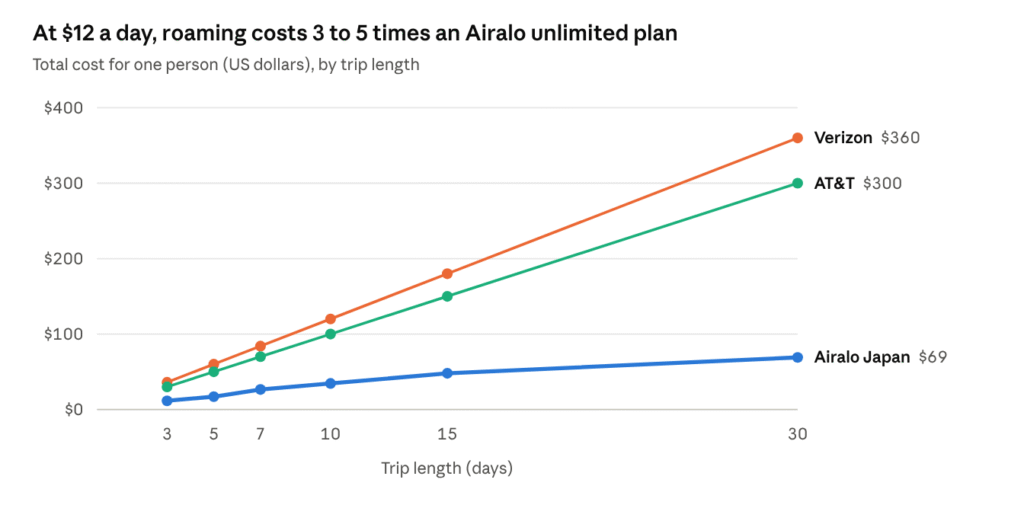
Airalo Japan unlimited prices (airalo.com) vs Verizon TravelPass $12/day and AT&T Day Pass $10/day · September 2026
The chart uses Airalo’s Japan unlimited plans, but its Europe plans track almost exactly: $27 for 7 days, $49 for 15 days and $71 for 30 days, compared with $26.50, $48 and $69 for Japan (Airalo Japan, Airalo Europe).
Three things stand out:
- Even the shortest trip favors the eSIM. For three days, Verizon’s pass costs $36 and AT&T’s $30, while Airalo’s 3-day unlimited plan is $11.50.
- The gap widens with time. On a 30-day trip, Airalo’s price works out to about $2.30 a day. A $12 day pass is more than five times that.
- Everything multiplies by the number of travelers. Day passes are charged per line. A couple on a two-week trip pays twice, and a family of four pays four times.
To be fair to the carriers, day passes have real advantages. There’s nothing to set up, and some include your regular talk and text allowance on your US number. On a single-day layover, or for someone who truly won’t touch their settings, that convenience can be worth it. But for most trips longer than a couple of days, the eSIM is the clear value choice, and unlimited isn’t even the cheapest Airalo option. If you don’t need unlimited data, a fixed pack costs less still.
How much data do you actually need?
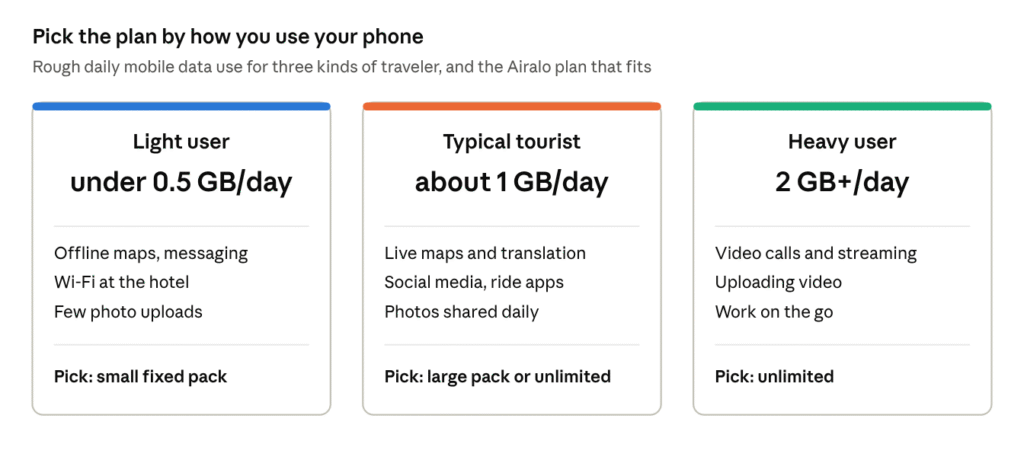
Before choosing a plan, it helps to know which kind of traveler you are. Most people overestimate how much data they’ll use abroad, because they’re thinking of how they use their phone at home, where video and music stream all day. On the road, you’re usually busy, often on Wi-Fi at the hotel or a café, and mostly using maps and messaging.
A Tokyo-based eSIM provider puts a typical tourist’s day of maps, translation, messaging and some social media at up to about 1 GB (Japan Wireless). That’s a useful middle anchor. Lighter users land well below it, and anyone streaming video or making video calls on cellular will blow past it.
Traveler data profiles · rough estimates, actual use varies
Here’s how to translate those profiles into a plan:
- Light users can usually get through a week with a small fixed pack. Download offline maps before you go, keep app updates and photo backups on Wi-Fi, and a few gigabytes goes a long way. This is also where Airalo’s $4 starter packs for popular countries make the most sense.
- Typical tourists land in the 5 to 10 GB range for a week. You can buy a mid-size pack and top up if needed, or buy unlimited and stop thinking about it. If the price difference is only a few dollars, unlimited is often worth it for peace of mind.
- Heavy users should go straight to unlimited. Video calls home, Instagram stories and working from a café without Wi-Fi add up quickly. Keep in mind that some unlimited plans slow down after a daily high-speed allowance, so check the plan details if you need consistently fast speeds.
Not sure which you are? Check your phone’s data usage for the past month. On an iPhone, go to Settings > Cellular and scroll down. On Android, look under Network & internet or Connections > Data usage. Divide by 30, then cut it roughly in half to account for the Wi-Fi you’ll find on the road. That’s a reasonable daily estimate.
One more tip: if you’re unsure, start small. Because Airalo lets you top up the same eSIM from the app, buying too little is an easy fix. Buying too much just means paying for data you didn’t use.
Scenario 1: A week in Japan
The trip: A couple flies from Los Angeles to Tokyo for seven days, with a couple of nights in Kyoto and a day trip to Nara. They’ll lean on Google Maps for train transfers, use a translation app at restaurants, and post photos along the way.
Japan is one of the best places to use a travel eSIM. The train system is superb but intricate, restaurant menus often aren’t in English, and a lot of daily logistics, from finding the right exit at Shinjuku Station to checking whether a temple is open, happen on your phone. Losing your connection for an hour is a real inconvenience.
The Airalo plan: Airalo’s Japan eSIM runs mainly on SoftBank, one of Japan’s big three carriers, with one other partner network also listed (Airalo Japan). Fixed packs start at $4. Unlimited plans cost $11.50 for 3 days, $17 for 5, $26.50 for 7, $34.50 for 10, $48 for 15 and $69 for 30.
For a typical tourist doing a lot of live navigation, the 7-day unlimited plan is the easy choice. A lighter user who downloads offline maps and relies on hotel Wi-Fi could get by on a mid-size fixed pack instead and save a few more dollars.
The math for two people:
| Option | Per person | Couple, 7 days |
|---|---|---|
| Airalo Japan, 7-day unlimited | $26.50 | $53 |
| AT&T International Day Pass ($10/day) | $70 | $140 |
| Verizon TravelPass ($12/day) | $84 | $168 |
The couple saves roughly $87 to $115 by switching to Airalo, before any Airmoney cashback. That’s a nice omakase dinner, or several days of rail fares.
Things to know before you go:
- Install before you board. Narita and Haneda both have Wi-Fi, but it’s easier to have everything ready so you can get on the train to the city without stopping.
- Expect data only. You won’t get a Japanese phone number. That rarely matters for tourists, since restaurants and hotels communicate through booking apps, email or messaging apps.
- Going on to Korea or elsewhere in Asia? Look at Airalo’s Asia regional plan, which starts at $4, instead of buying two separate local eSIMs.
- Prices have moved. Travel sites reported that Airalo raised its Japan unlimited prices in early 2026 (Travelsim Asia). Airalo is no longer the cheapest unlimited option for Japan, but it’s still a fraction of carrier roaming, and it’s a name you can trust to work on day one.
Scenario 2: Two weeks across Europe
The trip: Two friends from Chicago spend 14 days on a classic rail loop: London, Paris, Amsterdam, Munich, Venice and Rome. That’s six cities in five countries, with train rides that cross borders in the middle of the day.
This is where a regional eSIM really earns its keep. Buying a local SIM in each country would mean five stops at five phone shops. Even within the EU, where roaming rules make one European SIM work across member states, you’d still have to buy that first SIM on arrival, and the UK and Switzerland sit outside those EU rules.
The Airalo plan: Airalo’s Europe eSIM covers 41 countries on a single eSIM (Airalo Europe). You install it once at home, and your phone hops from one local network to the next as the train crosses each border. Airalo describes it as data that follows you “from the Eurostar to the Amalfi Coast.”
Unlimited plans cost $11.50 for 3 days, $19.50 for 5, $27 for 7, $35 for 10, $49 for 15 and $71 for 30. For a 14-day trip, the 15-day plan covers everything with a day to spare. Airalo also sells a separate European Union and United Kingdom plan, which is worth comparing if your trip stays within the EU and the UK.
The math for two people:
| Option | Per person | Two travelers, 14 days |
|---|---|---|
| Airalo Europe, 15-day unlimited | $49 | $98 |
| AT&T International Day Pass ($10/day) | $140 | $280 |
| Verizon TravelPass ($12/day) | $168 | $336 |
That’s a saving of roughly $180 to $240 for the pair, which covers a couple of high-speed train tickets or a very good dinner in Rome.
Things to know before you go:
- Check the country list. Forty-one countries covers the usual itineraries, but if your plans include somewhere outside the EU, such as Switzerland, the Balkans or Turkey, confirm it’s on the list before you buy.
- Border crossings are automatic, mostly. Your phone should switch networks by itself after you cross a border. If it doesn’t, toggling airplane mode on and off for a few seconds usually forces a reconnection.
- Trains and tunnels drop signal. No eSIM fixes a long tunnel through the Alps. Download your tickets and boarding passes to your phone’s wallet before you board.
- Consider a mid-trip top-up instead of a longer plan. If you’re not sure whether you’ll extend your trip, buy the plan for the days you know and top up later. You only pay for what you use.
Scenario 3: Mexico and Canada, where your plan may already cover you
The trip: A family from Dallas spends a long weekend in Cancún. Another traveler from Seattle drives up to Vancouver for four days.
Here’s where we’ll give you advice a pure sales pitch wouldn’t: check your current plan first. Mexico and Canada are the exception to the “roaming is expensive” rule for many Americans. Many US unlimited plans include some Mexico and Canada usage at no extra cost. AT&T, for example, includes both on most of its current unlimited plans (AvoidRoaming). If that’s you, you may not need anything else for a short trip.
Even then, there are good reasons to read the fine print:
- Included roaming often has limits. Some plans give you a smaller high-speed allowance in Mexico and Canada than at home, or slow your speeds after a threshold.
- Not every plan includes it. Older plans, many prepaid plans and some budget carriers don’t include Mexico and Canada, or charge extra. Verizon’s TravelPass, for example, costs $6 a day in both countries (Verizon).
- Long stays can be an issue. Plans that include international usage are designed for travel, not for spending months abroad. If you’re a snowbird wintering in Mexico, check your carrier’s terms.
The Airalo alternative: Airalo’s Mexico eSIM starts at $4, and Canada starts at $7. There’s also a North America regional plan that covers three countries on one eSIM, with unlimited data from $18.50 for 3 days (Airalo North America). It’s handy for road trips that cross a border more than once; confirm the country list in the app.
The math for the Cancún family (four people, four days): On Verizon’s TravelPass, four lines at $6 a day for four days is $96. Four small Airalo Mexico packs, starting at $4 each, can come in well under that. If each person just needs maps and messaging, the total can land around the price of a round of drinks at the resort.
Our honest take: If your plan already includes Mexico and Canada with enough high-speed data, you can skip the eSIM for a short trip. If it doesn’t, if you’re on Verizon paying $6 a day per line, or if you need more data than your plan gives you, a cheap Airalo pack is the easy fix.
Scenario 4: Business travelers, families and digital nomads
Not every trip fits neatly into “one week, one country.” Here’s how Airalo fits three traveler types whose needs are a little more complicated.
The frequent business traveler
The trip: A consultant based in New York flies to London, Frankfurt and Singapore over a single quarter, usually for three to five days at a time.
For this traveler, two things matter: keeping their US number reachable for clients, and not having to think about connectivity between meetings. Running the US line for calls and an Airalo eSIM for data covers both. Because each trip is short, a local or regional plan sized for the trip usually beats a carrier day pass by a wide margin, and those savings repeat every trip.
Frequent travelers also climb Airalo’s loyalty tiers quickly. At $200 in total spend, cashback reaches the top rate of 10% in Airmoney (Airalo loyalty program), which effectively takes a tenth off every future purchase. Companies that send many employees abroad can also look at Airalo for Business, which lets them assign eSIMs and control budgets centrally. Airalo says it can help companies reduce roaming costs by up to 90% (Airalo press release).
The family vacation
The trip: Two parents and two teenagers spend ten days in Italy.
With day passes, a family pays per line, so four phones on a $12-a-day pass for ten days comes to $480. With Airalo, each phone that supports eSIM gets its own plan, sized to the person. The parents, who handle navigation and bookings, might each take unlimited. The teens, who mostly want messaging and social media, might do fine with a mid-size pack and a top-up if they run low.
If a family member’s phone is older and doesn’t support eSIM, the phones that do can share a connection through a personal hotspot, as long as the plan allows it. Check hotspot rules in the plan details before you count on it.
The digital nomad
The trip: A remote software developer spends three months moving between Lisbon, Istanbul and Bangkok.
For long, multi-region stays, Airalo’s Global eSIM, which starts at $8.50, is the most flexible option. One eSIM follows you across continents, and you top it up as you go. For a month in one country, a local plan is usually cheaper, so many nomads combine the two: a local eSIM for long stays and a global eSIM as a backup for travel days and short stops. Since one phone can hold several eSIMs, switching between them is just a setting.
Your pre-trip checklist
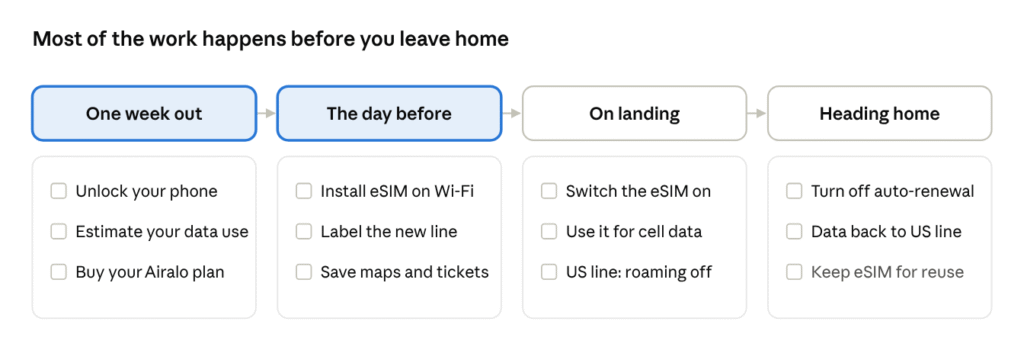
The secret to a smooth eSIM experience is doing almost everything before you leave. Here’s the whole process on one page.
Pre-trip checklist · four phases, not to scale
One week out. Confirm your phone is carrier-unlocked. If you’re not sure, call your carrier or check your account. An unlock can take a few days, and it’s the most common reason an eSIM won’t install. Then estimate your data needs using your phone’s usage history, and buy your plan. Since the validity period starts when you connect at your destination, buying early doesn’t waste any days.
The day before. Install the eSIM while you’re on reliable Wi-Fi. Label the new line something obvious, like “Airalo Japan” or “Airalo Europe”, so you won’t mix it up with your US line. Download offline maps for the cities you’re visiting, and save boarding passes, rail tickets and hotel confirmations to your phone.
On landing. Turn off airplane mode, switch on the Airalo line and set it as your line for cellular data. Follow Airalo’s instructions on data roaming for the eSIM line. On your US line, make sure data roaming is off, so your carrier doesn’t start a day pass. Give the phone a minute to find a local network.
Heading home. If you turned on auto-renewal, switch it off so you’re not charged for a package you won’t use. When you’re back in the US, set your US line as your cellular data line again. You don’t have to delete the Airalo eSIM. If top-ups are available for it, you can reuse it on your next trip to the same place.
Troubleshooting on arrival
Most of the time, an Airalo eSIM connects within a minute of landing. When it doesn’t, the fix is usually one of these, in roughly this order:
- Check the line is on and selected for data. Go to your phone’s cellular settings and make sure the Airalo line is turned on and chosen as the line for cellular data. It’s easy to leave your US line selected by accident.
- Check the data roaming setting on the eSIM line. Travel eSIMs usually need data roaming turned on for that line, since you’re technically roaming on a partner network. Follow the setup instructions in the Airalo app for your specific plan.
- Toggle airplane mode. Turn it on for about ten seconds, then off. This forces the phone to search for networks again, which often fixes a slow first connection.
- Restart your phone. It’s a cliché for a reason.
- Choose a network manually. If automatic network selection isn’t working, turn it off and pick one of the partner networks listed for your plan.
- Contact support. Airalo offers 24/7 support in multiple languages, including over WhatsApp. Have your order details ready, and be as specific as you can about what you’re seeing on your screen.
A few problems can’t be fixed on arrival, which is why the pre-trip checklist matters. If your phone is carrier-locked, you’ll need your US carrier to unlock it. If you accidentally deleted the eSIM from your phone, contact Airalo support rather than trying to reinstall it yourself, since many eSIMs can only be installed once.
And if you’re stuck with no connection at all? Most airports, cafes and hotels have free Wi-Fi, which is enough to reach Airalo support or install a new plan while you sort things out.
Quick answers to common cost questions
Is unlimited always the better deal? No. Unlimited is the better deal for heavy users and for anyone who hates watching a data meter. If you mainly use maps and messaging, a fixed pack usually costs less. Start small and top up if you need to.
Do Airalo prices include taxes? The prices in this post are the list prices shown on airalo.com. Carrier day-pass figures exclude taxes and fees, which can add a little more to your phone bill.
Can I combine Airmoney with a referral discount? Airalo’s referral page says you may not receive the referral discount if you’ve already used other promotions, so don’t count on stacking every offer. Airmoney you’ve earned can go toward future purchases.
What if my trip gets extended? Top up the same eSIM in the app. There’s no need to buy and install a new one, and you only pay for the extra days or data you need.
Is a regional plan more expensive than a local one? For the same number of days, a single-country plan is often the cheaper choice. A regional plan is worth it once you’re crossing borders, because one plan replaces several.
Should I cancel my carrier’s international add-on? If you’re paying a monthly international add-on you rarely use, it’s worth reviewing. Day passes like Verizon’s TravelPass are usually only charged on days you use them abroad, so there’s often nothing to cancel. Just keep data roaming off on your US line while you travel.
The bottom line
Let’s recap the numbers. For one week in Japan, a couple pays $53 with Airalo versus $140 to $168 with a carrier day pass. For two weeks in Europe, two travelers pay $98 versus $280 to $336. For a family of four spending ten days in Italy, day passes run $480 before anyone has streamed a single show.
The pattern is consistent. Carrier day passes are priced per day and per line, so they get more expensive with every extra day and every extra traveler. Airalo’s plans are priced by the trip, and the per-day cost falls the longer you stay. The only real exception is a short hop to Mexico or Canada on a US plan that already includes those countries.
What you get for the savings is more than money, too. You land with a working connection, you keep your US number for calls and bank texts, and you don’t have to find a SIM kiosk or keep track of a tiny plastic chip. And every paid purchase earns back 5% to 10% in Airmoney for next time.
If you haven’t set up an eSIM before, start with part one of this series for a walkthrough. Then pick your destination in the Airalo app, buy a plan a week before your trip, and install it the night before you fly. Your future self, standing in an arrivals hall with a working phone, will thank you.
All prices were checked on airalo.com, verizon.com and the linked sources in September 2026. Prices and carrier policies change often, so confirm current rates before you buy. Carrier roaming figures are per line and exclude taxes and fees.